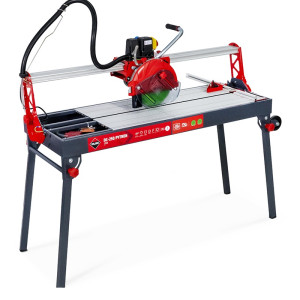
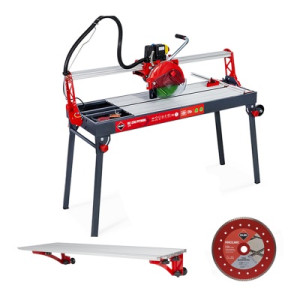
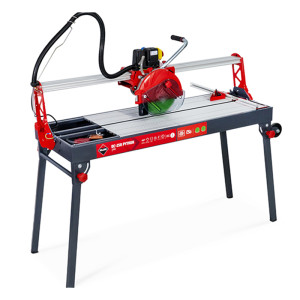
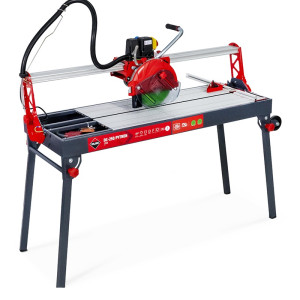
Why Choose A Wet Table Saw
Cutting thick 20mm porcelain or natural sandstone dry is a recipe for jagged edges and burnt-out blades. A porcelain table saw uses a continuous flow of water to act as a lubricant and coolant, which is vital for several reasons:
✓ Chip-Free Finish
The water keeps the diamond blade cool, allowing it to grind through dense materials without causing the “shudder” that leads to chips.
✓ Safety First
Wet cutting suppresses harmful silica dust, keeping your lungs safe and your workspace clean.
✓ Blade Longevity
By preventing overheating, the water-cooling system ensures your diamond blades last through the entire project.
How To Choose A Stone & Porcelain Table Saw For Your Project
When selecting your stone table saw, the most critical factor is the bed length. For modern 900×600 slabs, you need a saw with a cutting capacity of at least 900mm to handle longitudinal cuts.
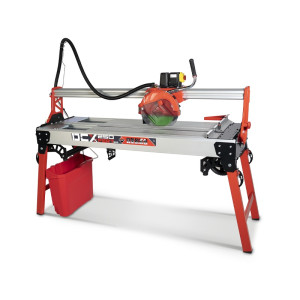
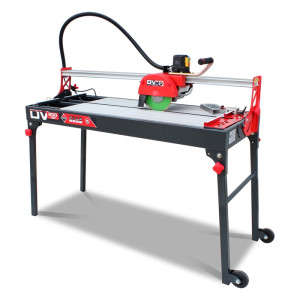
If you are a homeowner doing a one-off patio, a mid-range stone-cutting table saw like the Rubi DV-200 offers great value. For trade professionals, we recommend the DC or DCX series, which feature more powerful motors and reinforced chassis for intensive daily use.
Why Choose Pegseo Stone For Your Home Improvement Project?
As a direct importer, Pegseo Stone offers table stone saws for sale with trade and wholesale discounts, backed by our 2-3 day delivery and expert, personalised customer service.
✔ Premium quality guaranteed – carefully sourced materials that stand the test of time.
✔ Trade & domestic support – whether you need a bulk supply or a single hardwearing patio, we tailor our advice to you. Contact us today for any advice.
✔ End-to-end service – from samples and technical guidance to installation accessories, we make the process simple.
✔ Proven results – our porcelain has enhanced countless patios, paths, driveways, and cladding projects across the UK.
Google reviews
Wet Table Saws FAQs
How do I use my wet table saw?
Here are a few tips on how to best use your table saw for maximum safety and efficiency:
- Always ensure the water reservoir is full and the pump is flowing freely before the blade touches the material.
- Position your slab firmly against the fence, align your cut mark with the blade’s path, and let the motor reach full speed before you begin.
- When cutting, apply light, consistent pressure and let the diamond blade do the work.
- Avoid forcing the slab through too quickly, as this can cause the blade to wander or the tile to crack.
- Once the cut is complete, pull the motor head back or slide the table to the starting position only after the blade has come to a complete stop to ensure your safety and a clean finish.
Can I use a standard wood saw for porcelain?
No, wood saws use teeth to rip through material, which would instantly shatter porcelain or stone. You must use a specialised wet saw with a diamond-rimmed blade.
Do I need a special blade for 20mm porcelain?
Yes, while a general-purpose blade works for ceramic, 20mm outdoor porcelain is much harder. We recommend a continuous rim diamond blade specifically rated for porcelain to get a smooth, factory-edge finish.
How often should I change the water in the reservoir?
You should refresh the water as soon as it looks like “sludge.” Dirty water carries abrasive particles that can actually scratch your tiles and wear down the water pump.